
 By
Most people buy a soccer ball in about two minutes. Then they spend the whole season wondering why it feels wrong.
The ball is too big for a seven-year-old. It’s flat every Saturday. Or it’s a $90 match ball getting shredded on concrete.
This guide fixes that. You’ll find the soccer ball size chart, official rules, ball types, materials, pressure recommendations and practical advice on choosing, inflating and maintaining a ball.
Whether you’re a parent buying a child’s first ball, a coach selecting equipment for a team or a player looking for better control, you’ll know exactly what to look for.
What Is a Soccer Ball?
A soccer ball is a spherical, air-filled ball used to play association football. Players kick it, pass it, head it and control it throughout a match.
An official size 5 soccer ball measures 68 to 70 cm (27 to 28 inches) in circumference and weighs 410 to 450 grams (14 to 16 ounces) at the start of a match, according to Law 2 of the IFAB Laws of the Game.
IFAB, the International Football Association Board, establishes the Laws of the Game. These rules define the basic requirements for match balls, while youth competitions and other formats have their own specifications.
What Is a Soccer Ball Used For?
A soccer ball is the essential piece of equipment for football. Players use it for competitive matches, team practices, individual drills and recreational games.
Different balls serve different purposes. A match ball prioritizes performance and consistent flight, while a training ball is usually designed to handle frequent use. A futsal ball has a reduced bounce for indoor court play.
Choosing the right ball depends on the player’s age, competition, playing surface and skill level.
Soccer Ball vs Football: What’s the Difference?
They’re generally the same ball. Americans commonly say soccer ball, while most countries call it a football.
The word soccer developed from association football, helping distinguish the sport from other forms of football. In American football, however, a football is a different, oval-shaped ball.
Soccer Ball Size Chart: Sizes, Age, Weight and Circumference
Soccer balls come in different sizes to suit players at different stages of development. The most common playing sizes are 3, 4 and 5, while sizes 1 and 2 are mainly used for skills and recreational training.
Use this chart as a starting point. Your league’s rules and the manufacturer’s specifications should determine the final choice.
| Ball size | Typical age | Circumference | Approx. weight | Best for |
| Size 1 (mini) | Any age | 18–20 in (45–51 cm) | Varies | Skills and touch training |
| Size 2 | Young children | 20–22 in (51–56 cm) | Varies | Footwork and recreational play |
| Size 3 | 8 and under | 23–24 in (58–61 cm) | 10.5–11.3 oz (300–320 g) | Young beginners |
| Size 4 | Usually 8–12 | 25–26 in (63.5–66 cm) | 12.3–13.8 oz (350–390 g) | Youth football |
| Size 5 | 13 and older | 27–28 in (68–70 cm) | 14.5–15.9 oz (410–450 g) | Adult and official match play |
Note: Size 3 and 4 weights are common standard-ball reference ranges, not universal requirements for every youth competition. Lightweight versions and manufacturer specifications can differ. Age recommendations also vary between leagues.
For another manufacturer reference, see the Nike soccer ball size chart.
Size 1 and Size 2 Soccer Balls
A size 1 soccer ball, often called a mini ball, measures approximately 18 to 20 inches around. It isn’t normally used for competitive matches. Players use it for footwork, close control and improving their touch.
Size 2 balls measure approximately 20 to 22 inches around. They’re useful for young children and recreational skill exercises.
Neither size replaces the regulation ball required for a player’s league.
Size 3 Soccer Ball
A size 3 soccer ball is mainly used by children aged 8 and under. Its smaller circumference makes it easier for young players to control, kick and practice basic football skills.
It typically measures 23 to 24 inches around and weighs approximately 300 to 320 grams, although some lightweight models differ.
Size 4 Soccer Ball
A size 4 soccer ball is commonly used in youth football, particularly for players aged around 8 to 12.
It measures approximately 25 to 26 inches in circumference and typically weighs 350 to 390 grams.
The smaller size helps developing players work on passing, shooting and ball control before moving to the full-size ball.
Size 5 Soccer Ball
A size 5 soccer ball is the standard adult and official 11-a-side match size. It’s generally recommended for players aged 13 and older, depending on competition rules.
Under IFAB Law 2, a regulation size 5 match ball must measure 68 to 70 cm in circumference and weigh 410 to 450 grams at the start of the match.
It’s used in adult leagues, professional football and most competitive matches at the appropriate age level.
How to Measure a Soccer Ball
You can check a soccer ball’s circumference with a flexible measuring tape.
- Inflate the ball to its recommended pressure.
- Place the measuring tape around the widest part of the ball.
- Keep the tape snug without squeezing the cover.
- Record the circumference.
- Compare the measurement with the manufacturer’s size specifications.
Don’t measure straight across the middle. That’s the diameter, not the circumference.
Official Soccer Ball Rules and FIFA Standards
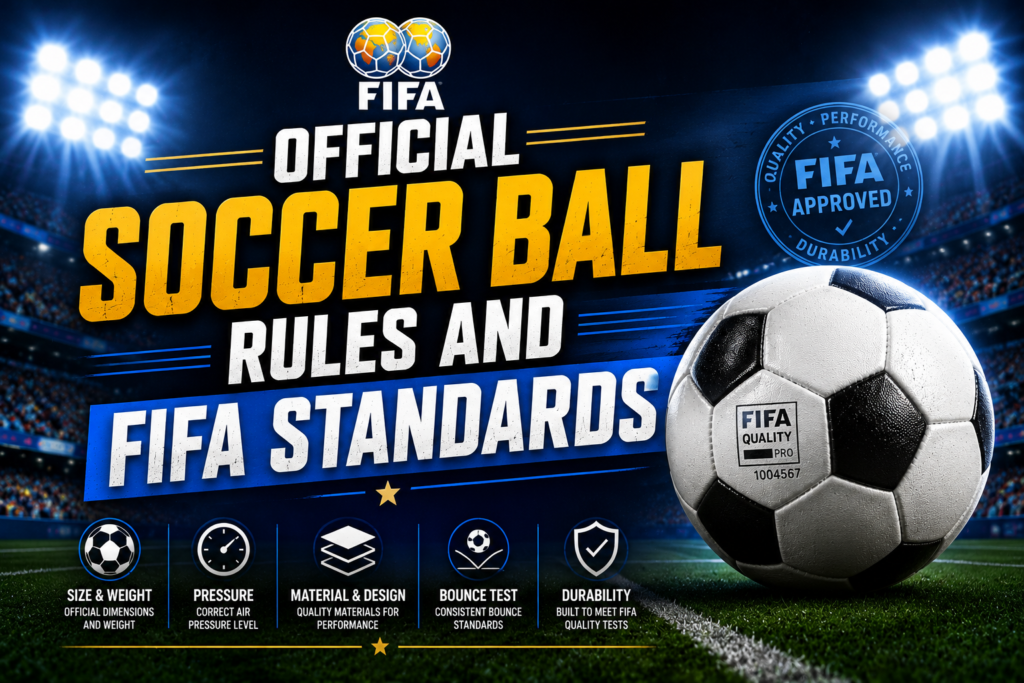
IFAB Law 2 establishes the minimum specifications for footballs used in association football matches. These requirements help ensure that match balls have consistent dimensions, weight and pressure.
Official Soccer Ball Size, Weight and Pressure
According to IFAB Law 2: The Ball, a regulation match ball must meet these requirements:
- Shape: Spherical.
- Material: Made of suitable material.
- Circumference: 68 to 70 cm (27 to 28 inches).
- Weight: 410 to 450 grams (14 to 16 ounces) at the start of the match.
- Pressure: 0.6 to 1.1 atmospheres at sea level, approximately 8.5 to 15.6 PSI.
These specifications apply to the standard size 5 match ball. Smaller youth balls follow different specifications.
The Laws also state that a defective ball must be replaced under the referee’s control and that a ball cannot be changed during a match without the referee’s permission.
FIFA Quality Marks and Testing Requirements
FIFA operates a quality programme that tests footballs against technical performance and durability requirements.
The current programme has three quality marks:
- FIFA Basic: Focuses on minimum performance, safety, accuracy and durability requirements.
- FIFA Quality: Places greater emphasis on durability and safety, while testing basic performance.
- FIFA Quality Pro: Designed for the highest level of competition, with demanding performance, accuracy and safety requirements.
FIFA Basic replaced the older International Match Standard (IMS) mark. Previously certified IMS balls may remain eligible until their certification expires.
Testing can cover circumference, weight, roundness, rebound, water absorption, pressure loss and shape retention.
A FIFA quality mark is useful when selecting a competitive match ball because it indicates that the ball has passed the relevant independent testing requirements.
You can read more in the FIFA Quality Programme explanation.
Do Youth Soccer Leagues Follow the Same Ball Rules?
No. Youth leagues use smaller balls to suit younger players.
For example, many youth football programmes use size 3 for younger age groups, size 4 for intermediate youth groups and size 5 for older players.
US youth guidelines commonly use size 3 for U8 and younger, size 4 for U9 through U12, and size 5 for U13 and older. However, individual competitions can have different requirements.
Always ask the coach or check the league’s equipment rules before buying a ball for a team.
Different Types of Soccer Balls
Not every soccer ball is designed for the same environment. Match balls, training balls, indoor balls and futsal balls have different construction and performance characteristics.
Match Balls
Match balls are designed for competitive games. They focus on consistent flight, accurate passing, reliable bounce and responsive touch.
Higher-quality models often feature soft polyurethane covers, carefully constructed panels and advanced bonding techniques.
Professional match balls may carry FIFA quality marks, depending on the competition’s requirements.
They’re generally more expensive than basic training balls, so using them on rough concrete or abrasive surfaces can wear down the cover quickly.
Training Balls
Training balls are designed to handle regular practice sessions. Coaches and players use them for passing drills, shooting practice, ball control and small-sided games.
They often have tougher covers and durable construction to withstand repeated contact with different playing surfaces.
For everyday training, look for:
- The correct size for the player.
- A durable cover suitable for the playing surface.
- A bladder that maintains pressure reliably.
- Strong stitching or bonding.
- A clearly printed inflation range.
The most expensive ball isn’t automatically the best training ball. Durability and suitability matter more than appearance.
Indoor Soccer Balls
Indoor soccer balls are designed for hard indoor surfaces. Depending on the indoor football format, they may have a different cover, construction and bounce from outdoor balls.
Traditional indoor soccer often uses walls and may use a ball designed specifically for that format.
Futsal is a separate form of indoor football with its own ball requirements. The two should not be treated as interchangeable.
Futsal Balls
A futsal ball is usually a size 4 ball with a reduced bounce. It’s designed for quick passes, close control and play on hard indoor courts.
Under the FIFA Futsal Laws of the Game, an official futsal ball must have:
- Circumference of 62 to 64 cm.
- Weight of 400 to 440 grams at the start of the match.
- Pressure of 0.6 to 0.9 atmospheres at sea level.
- First rebound of 50 to 65 cm when dropped from a height of 2 metres.
The lower bounce helps keep the ball closer to the floor, which suits futsal’s fast-paced style.
A regular youth size 4 ball is not automatically a futsal ball. The low-bounce construction is an important difference.
See Futsal Law 2: The Ball for the official specifications.
How to Choose the Right Soccer Ball

The right soccer ball should match the player’s age, playing environment and level of use. Follow these factors before buying.
Choosing a Ball Based on Age and Skill Level
Start with the player’s age and competition requirements.
Younger children generally need size 3 balls, youth players commonly use size 4, and older teenagers and adults usually use size 5.
Skill level also matters. Beginners benefit from a durable ball that’s easy to control, while competitive players may prefer a match-quality ball with more consistent flight and touch.
A goalkeeper uses the same match ball as the rest of the team. Position doesn’t determine ball size.
Choosing a Ball for Grass, Turf and Concrete
Playing surface affects how quickly a soccer ball wears out.
Natural grass: A good-quality PU-covered ball provides a responsive touch and is suitable for regular outdoor play.
Artificial turf: Look for a durable cover that can withstand repeated contact with the synthetic surface. The ball should also suit the turf’s speed and playing characteristics.
Concrete and rough ground: Choose a tougher, abrasion-resistant ball. PVC and durable TPU covers are common options for recreational use. Avoid expensive match balls on rough surfaces because their covers can wear quickly.
Indoor courts: Use a ball designed for the relevant indoor format. Futsal requires a low-bounce ball.
Soccer Ball Materials: PU vs PVC
The outer cover affects how a soccer ball feels, performs and handles regular use.
Polyurethane (PU): PU covers are generally softer and provide a responsive feel. They’re commonly used on higher-quality training and match balls.
Polyvinyl chloride (PVC): PVC is generally tougher and more affordable. It’s often found on recreational and entry-level balls, although the feel can be firmer.
Thermoplastic polyurethane (TPU): TPU is used in many durable ball covers. Its performance depends on the formulation and construction.
No single material is best for every player. Choose based on touch, durability, surface and budget.
Soccer Ball Bladders: Latex vs Butyl
The bladder is the inner part that holds air. Two common materials are latex and butyl.
Latex bladder: Latex bladders are often associated with a softer, responsive feel. However, they generally lose air faster and may need more frequent inflation.
Butyl bladder: Butyl bladders usually retain air longer, making them convenient for regular training and recreational use.
If you want a ball that stays inflated between sessions, butyl is often a practical choice. If touch and responsiveness are your priority, consider a quality ball with a latex bladder.
Hand-Stitched, Machine-Stitched and Thermally Bonded Balls
The way a ball’s panels are joined affects its construction, feel and durability.
Hand-stitched balls: Panels are joined by hand. Quality hand stitching can create durable seams, particularly in well-made match balls.
Machine-stitched balls: Machines join the panels, making production faster and often more affordable.
Thermally bonded balls: Heat and pressure join the panels without traditional stitching. This can reduce exposed seams and help limit water absorption.
The joining method alone doesn’t determine quality. Materials, manufacturing standards and overall construction also matter.
How Much Should You Spend on a Soccer Ball?
Your budget should reflect how often the ball will be used.
For children under 8 and casual backyard play, a correctly sized, durable ball is usually enough. Spending a large amount on a professional match ball isn’t necessary.
For regular team training, invest in a ball that can handle repeated use and retain its shape.
Competitive players may benefit from a higher-quality match ball, especially one carrying an appropriate FIFA quality mark.
The best purchase is a ball that suits the player and playing surface, not simply the most expensive option.
Soccer Ball Construction and Components
A soccer ball may look simple, but its construction involves several parts working together. The bladder, lining, cover, panels and valve all contribute to its shape and performance.
How Many Panels Does a Soccer Ball Have?
The traditional soccer ball design has 32 panels: 12 pentagons and 20 hexagons.
Adidas introduced the famous black-and-white Telstar design at the 1970 FIFA World Cup. Its contrasting panels made the ball easier to see on black-and-white television.
Modern footballs don’t have to follow the traditional 32-panel pattern. Manufacturers have experimented with different panel shapes and counts.
For example, the Adidas Teamgeist used 14 panels in 2006, while the Jabulani used eight panels in 2010.
The 2026 FIFA World Cup ball, Adidas TRIONDA, uses a four-panel construction with connected-ball technology. Its design represents the three host nations: Canada, Mexico and the United States.
What Are the Layers Inside a Soccer Ball?
Most modern soccer balls have three main construction layers:
1. Outer cover
The cover is the outside surface that players kick, pass and control. It is commonly made from synthetic materials such as PU, PVC or TPU.
2. Lining
The lining sits beneath the cover. It adds support, helps maintain the ball’s shape and contributes to its feel.
3. Bladder
The bladder is the air-holding component inside the ball. It is commonly made from latex or butyl.
Together, these components help the ball maintain its round shape, pressure and playing characteristics.
How Does a Soccer Ball Valve Work?
The valve is the small opening used to inflate the ball. Most modern soccer balls have a one-way valve that helps keep air inside after the pump needle is removed.
Always use a suitable ball needle and insert it carefully. Forcing a dry or incorrectly sized needle into the valve can damage it and cause air leaks.
How to Inflate a Soccer Ball
Correct inflation helps a soccer ball maintain its shape and perform consistently. Too little pressure can make the ball feel heavy and difficult to control, while too much pressure can strain the bladder and seams.
Follow these steps:
- Get a ball pump with a compatible inflation needle.
- Moisten the needle with a little water before inserting it.
- Hold the ball steady and insert the needle straight into the valve.
- Inflate slowly rather than forcing air into the ball.
- Check the pressure with a suitable gauge.
- Stop when the ball reaches the pressure range printed near its valve.
- Remove the needle carefully.
Never force the needle or inflate the ball beyond the manufacturer’s recommended range.
Recommended Soccer Ball Pressure in PSI
Under IFAB Law 2, a standard size 5 match ball must have a pressure of 0.6 to 1.1 atmospheres at sea level, equivalent to approximately 8.5 to 15.6 PSI.
However, this is not a universal pressure range for every soccer ball.
Youth, training and recreational balls can have different recommended pressures. The manufacturer’s pressure range printed near the valve should always take priority.
Latex-bladder balls may lose air faster than butyl-bladder balls, so check their pressure before playing.
How to Use a Ball Pump and Pressure Gauge
A ball pump with a pressure gauge makes inflation easier and reduces the risk of overinflating.
Attach the compatible needle, moisten it, insert it gently and pump in small amounts. Check the pressure regularly rather than relying on how firm the ball feels.
A suitable bike pump can also work if it has a compatible ball needle and allows you to monitor pressure accurately.
Signs Your Soccer Ball Is Overinflated or Underinflated
An underinflated soccer ball feels soft, may lose its round shape and often travels less predictably.
An overinflated ball feels unusually hard and can place unnecessary stress on its seams and bladder.
Don’t rely only on squeezing the ball. Use a pressure gauge and compare the reading with the manufacturer’s recommended range.
Soccer Ball Cleaning, Storage and Maintenance
Regular cleaning and proper storage help protect a soccer ball’s cover, seams and valve.
A little maintenance can extend the life of a ball, especially if it’s used frequently.
How to Clean a Soccer Ball
Follow these simple steps:
- Remove loose dirt with a dry cloth.
- Mix a small amount of mild soap with water.
- Wipe the ball gently with a damp cloth.
- Remove soap residue using another clean, damp cloth.
- Let the ball air-dry in a cool, shaded area.
Don’t soak the ball or use harsh chemicals and abrasive brushes. Excessive moisture and aggressive cleaning can damage some covers, seams and valves.
Keep the ball away from heaters, hair dryers and direct sunlight while drying.
How to Store a Soccer Ball
Store your soccer ball in a cool, dry place when you’re not using it.
Avoid leaving it in a hot car, near heating equipment or in direct sunlight for long periods. Extreme temperatures can affect pressure and material performance.
Don’t place heavy objects on top of the ball or store it near sharp tools and rough equipment.
Check the pressure occasionally, especially if the ball hasn’t been used for several weeks.
How Long Does a Soccer Ball Last?
A soccer ball’s lifespan depends on its construction, playing surface and frequency of use.
A quality ball used on natural grass may last considerably longer than a basic ball used every day on rough concrete.
Check the ball regularly for:
- Split or damaged seams.
- Peeling or cracked outer material.
- A damaged inflation valve.
- Loss of round shape.
- Air leaks that continue after inflation.
Replace the ball when damage affects its shape, pressure retention or safe use.
When to Replace a Soccer Ball
A ball doesn’t need replacing simply because it looks dirty or has lost some color.
However, if its cover is separating, the seams are opening, the bladder is leaking or it no longer holds a consistent shape, replacement is usually the better option.
A ball that behaves unpredictably can make training and matches less enjoyable.
History and Evolution of the Soccer Ball
Soccer balls have changed considerably over the years. Early footballs were made from animal bladders covered in leather, while modern versions use synthetic materials and advanced construction techniques.
Who Invented the Soccer Ball?
No single person invented the modern soccer ball.
Early footballs often used inflated animal bladders covered with leather. Their size and shape could vary because natural bladders weren’t uniform.
Charles Goodyear’s work on vulcanized rubber helped make more consistent rubber products possible. He designed and produced a treated rubber ball in 1855.
Richard Lindon later helped develop inflatable rubber bladders for footballs in the 1860s. These developments made it easier to produce balls with more consistent shapes and sizes.
The modern soccer ball emerged through decades of improvements in materials, manufacturing and football regulations.
How World Cup Soccer Balls Have Changed
World Cup match balls have changed from traditional stitched leather designs to modern synthetic balls with advanced panel construction.
Some important milestones include:
- 1970 – Adidas Telstar: Introduced the famous 32-panel black-and-white design that became an iconic football look.
- 2006 – Adidas Teamgeist: Used a 14-panel construction instead of the traditional 32-panel design.
- 2010 – Adidas Jabulani: Introduced an eight-panel design and new surface technology.
- 2026 – Adidas TRIONDA: Featured a four-panel design, embossed surface details and connected-ball technology.
For the 2026 FIFA World Cup, Adidas also introduced the TRIONDA FINAL for the tournament’s final four matches. It retained the four-panel construction while introducing a special design for the closing stages.
These developments show how football manufacturing continues to evolve while the basic requirements for a regulation match ball remain defined by Law 2.
Final Thoughts
Choosing the right soccer ball comes down to size, material, playing surface and pressure. Match the ball to the player’s age and skill level, choose a suitable type for your playing conditions, and follow the recommended inflation range. With the right ball and proper care, you can enjoy better control, consistent performance and longer-lasting use.
Frequently Asked Questions
What size soccer ball should a 10-year-old use?
A 10-year-old will generally use a size 4 soccer ball. Many youth competitions use size 4 for players in the U9 to U12 age groups. Always check the local league’s equipment rules.
What is the difference between a size 4 and size 5 soccer ball?
A size 4 ball measures approximately 25 to 26 inches in circumference, while a size 5 measures 27 to 28 inches. Size 4 is commonly used in youth football, while size 5 is the standard adult match size.
How much does a size 5 soccer ball weigh?
An official size 5 match ball weighs between 410 and 450 grams (14 to 16 ounces) at the start of the match, according to IFAB Law 2.
What PSI should a size 5 soccer ball have?
IFAB Law 2 specifies 8.5 to 15.6 PSI at sea level for an official size 5 match ball. For recreational and training balls, follow the manufacturer’s recommended pressure.
Why does my soccer ball keep losing air?
Some air loss is normal, particularly with latex-bladder balls. However, if a ball becomes flat quickly, check its valve and bladder for damage.
You can apply a little soapy water around the valve and look for bubbles. Continuous bubbling may indicate a leak.
Can adults use a size 4 soccer ball?
Yes. Adults can use size 4 balls for recreational play and skill training. However, official adult 11-a-side matches generally use size 5 balls
Can I use a futsal ball outside?
You can use one for casual outdoor practice, but regular play on rough grass or concrete can damage its cover. Futsal balls are designed primarily for hard indoor courts.
Is a PU or PVC soccer ball better?
PU generally provides a softer, more responsive feel, while PVC is often more affordable and durable for basic recreational use. The best choice depends on the ball’s construction and playing surface.
How often should I inflate a soccer ball?
Check the pressure before each match or training session. How often the ball needs additional air depends on its bladder material, condition and storage.
Can I use a regular pump to inflate a soccer ball?
Yes, provided the pump has a compatible ball needle and you can check the pressure accurately. A dedicated ball pump with a gauge is a convenient option.